


Call us now
08037103723

 Send Inquiry
Fanless Cooling Tower
Price 50000 INR/ Unit
Fanless Cooling Tower Specification
- Material
- FRP
- Application
- Industrial
- Height
- 60 Millimeter (mm)
- Product Type
- Fanless Cooling Tower
- Voltage
- 220-480 Volt (v)
- Weight
- 500 Kilograms (kg)
- Color
- Orange and Blue
- Length
- 120 Foot (ft)
Fanless Cooling Tower Trade Information
- Minimum Order Quantity
- 1 Unit
- Payment Terms
- Cheque, Cash in Advance (CID), Cash Advance (CA)
- Supply Ability
- 1 Unit Per Month
- Delivery Time
- 3-4 Week
- Main Domestic Market
- Gujarat
About Fanless Cooling Tower
A cooling tower that doesn't employ fans or blowers to promote air circulation is referred to as a fanless cooling tower, natural draught cooling tower, or a passive cooling tower. These towers use buoyancy and natural convection to create airflow and remove heat instead.
The notion of stack effect or chimney effect underlies the operation of a fanless cooling tower. Due to the lower density of warm air, it rises naturally within the tower, creating a pressure difference that allows cooler air from the surroundings to enter the tower through apertures at the base. This innate airflow enables cooling by allowing heat to be transferred from the water to the air.
The main parts and characteristics of a fanless cooling tower are as follows:
1. Fanless cooling towers are typically tall buildings with a chimney-like shape. The tower's height enables the generation of a significant enough pressure difference to propel natural convection airflow.
2. Fill Media: To enhance the surface area available for heat transfer, fill media, such as hardwood slats, PVC sheets, or other materials, are utilised. The fill medium permits contact between the water and the air, which facilitates effective cooling.
3. Water Distribution System: To provide appropriate wetting and maximum contact between the water and the air for efficient cooling, water is distributed evenly throughout the fill media using a water distribution system.
Fanless cooling towers have the following benefits:
1. Energy Efficiency: Fanless cooling towers use less energy than fan-assisted cooling towers since they don't need fans or blowers to operate. As a result, operational costs are decreased.
2. Reduced Noise: Without the noise made by fan-driven systems, fanless cooling towers run silently.
3. Lower Maintenance: Fanless cooling towers require less maintenance because there are fewer mechanical parts to replace.
Fanless cooling towers do have some drawbacks, though:
1. Fanless cooling towers are often appropriate for smaller applications with lower heat loads because of their limited cooling capacity. Compared to fan-assisted towers, their cooling capability could be constrained.
2. Weather Dependence: Aspects of the outside weather, such as wind speed, temperature, and humidity, might affect how well a fanless cooling tower performs. The circulation and cooling effectiveness of natural convection can be impacted by calm weather or low wind conditions.
In places like small-scale industrial processes, commercial buildings, and power plants, where lesser cooling requirements or energy efficiency are valued, fanless cooling towers are frequently employed. They are an efficient cooling method because of their simplicity and reliance on natural convection.
Advanced Fanless Technology
This cooling tower employs a fanless design, leveraging natural draft principles to achieve efficient heat dissipation without mechanical assistance. The absence of fans significantly lowers operational costs and maintenance requirements, enhancing its suitability for various industrial applications.
Durable FRP Construction
Made from premium-grade Fiber Reinforced Plastic (FRP), this tower offers exceptional resistance to corrosion, chemicals, and harsh weather conditions. Its robust construction ensures longevity and consistent reliability for continuous industrial use.
Versatile Industrial Applications
Engineered for heavy-duty use, the fanless cooling tower is ideal for factories, refineries, and process plants. Its adaptable voltage range (220-480V) and extensive footprint make it a preferred choice for diverse industries across India.
FAQ's of Fanless Cooling Tower:
Q: How does a fanless cooling tower operate without a fan?
A: A fanless cooling tower relies on natural draft technology, using the temperature difference between the air and water to facilitate heat transfer without the need for mechanical fans. This process reduces noise and energy consumption, making it a cost-effective solution for industrial cooling.Q: What are the benefits of using FRP (Fiber Reinforced Plastic) in the cooling tower?
A: FRP provides excellent durability, corrosion resistance, and chemical stability. This means the tower can withstand demanding industrial conditions, delivering long service life with minimal maintenance requirements compared to towers made from conventional materials.Q: When is it suitable to use a fanless cooling tower in an industrial setting?
A: Fanless cooling towers are ideal when silent operation, low maintenance, and high energy efficiency are priorities. They are particularly effective in environments where electricity supply may vary or where environmental noise regulations must be observed.Q: Where can this fanless cooling tower be installed?
A: These towers are designed for installation in a variety of industrial facilities across India, such as manufacturing plants, chemical processing sites, and refineries. Their extensive length and compact height make them adaptable to different plant layouts.Q: What is the installation process for this cooling tower?
A: The installation typically involves site preparation, positioning the tower, and connecting it to existing water circulation and electrical systems. As these are large units (120 feet in length), installation may require specialized handling and alignment services, which can be provided by the manufacturer or supplier.Q: How can industries benefit from using a fanless cooling tower?
A: Industries benefit from reduced operational costs due to the absence of energy-consuming fans, lower noise pollution, and fewer moving parts that require maintenance. The fanless design also enhances safety and operational reliability.Q: What applications best match the capabilities of this fanless cooling tower?
A: This cooling tower is suited for heavy-duty applications in industrial sectors such as power generation, petrochemicals, textiles, and large-scale manufacturing processes where highly efficient, silent, and robust cooling systems are needed.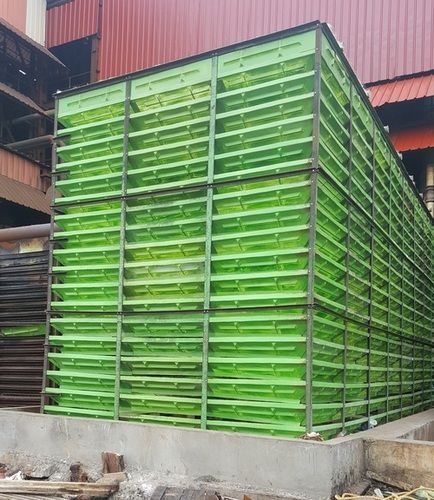

Price:
- 50
- 100
- 200
- 250
- 500
- 1000+

More Products in Cooling Towers Category
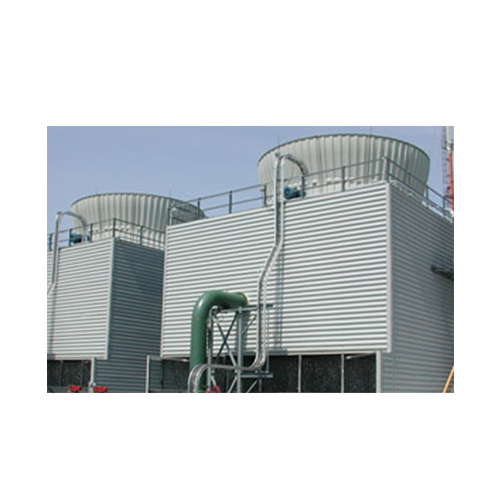
Forced Draft Cooling Tower
Minimum Order Quantity : 1 Unit
Application : Industrial Cooling
Voltage : 440 V
Material : Other , FRP (Fibre Reinforced Plastic)
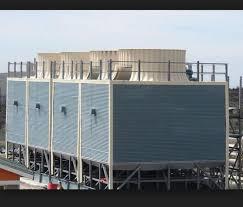
FRP Pultruded Cooling Tower
Price 50000 INR / Unit
Minimum Order Quantity : 1 Unit
Application : Industrial
Voltage : 220 Volt (v)
Material : Metal
Height : 60 Millimeter (mm)

FRP Plutruded Counter Flow Cooling Tower
Price 100000 INR / Set
Minimum Order Quantity : 1 Unit
Application : Industrial
Voltage : 220480 Volt (v)
Material : Other , FRP
Height : 60 Millimeter (mm)

Industrial Cooling Tower
Price 50000 INR / Unit
Minimum Order Quantity : 1 Unit
Application : Industrial
Voltage : 220480 Volt (v)
Material : Metal
Height : 60 Millimeter (mm)

GST : 24AADFM1173B1ZX


 Send Inquiry
 Send Inquiry
 Send SMS
 Call Me Free
Developed and Managed by Infocom Network Private Limited.

